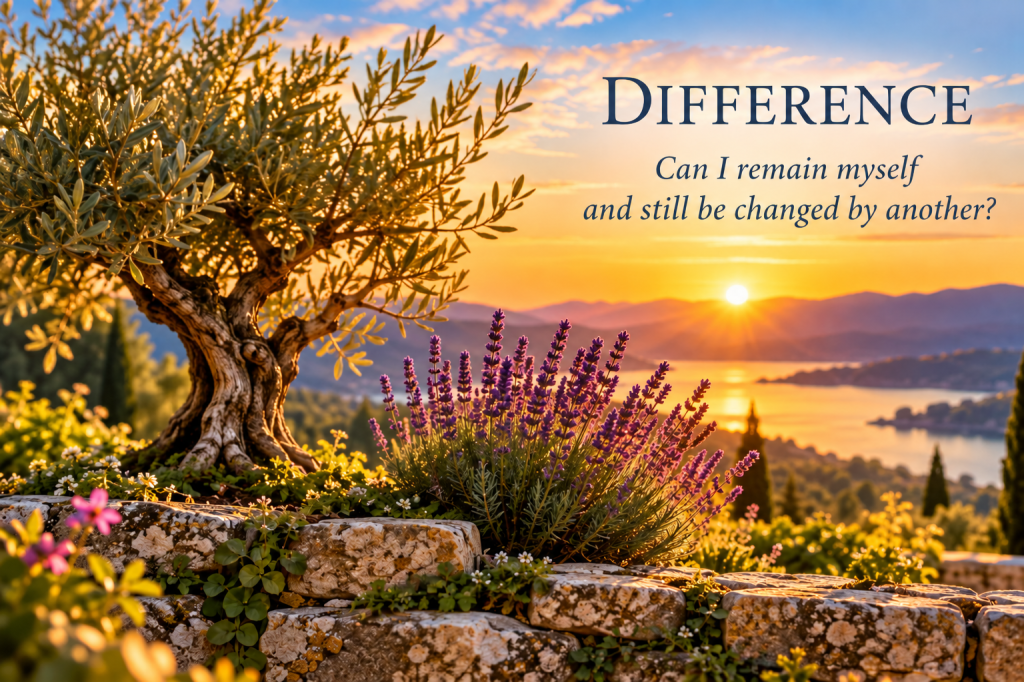
Sometimes difference feels like a threat.
Someone sees the world differently than we do. They believe something we don’t believe, want something we don’t want, or respond to life in a way that makes little sense to us.
Almost without noticing, we may begin trying to close the distance.
We explain.
We persuade.
We defend.
We withdraw.
Or we become quieter about what is true for us in order to preserve the relationship.
It can begin to seem as though there are only two possibilities: one of us must change, or we must move farther apart.
But perhaps there is another possibility.
What if difference does not always have to be resolved?
What if I can remain fully myself while allowing you to remain fully yourself—and still become genuinely curious about what exists between us?
This does not mean that every difference is harmless. Boundaries matter. Values matter. Some differences require us to say no, to protect what matters, or even to leave.
But difference itself is not necessarily the problem.
An olive tree does not need to become lavender in order to share the same garden.
Each has its own form, its own requirements, its own way of responding to light and soil. Their difference is not a failure of relationship. It is part of what makes the garden possible.
Perhaps human relationships can sometimes hold difference in much the same way.
Not by erasing what distinguishes us.
Not by pretending disagreement doesn’t matter.
And not by requiring either of us to surrender ourselves in order to belong.
Instead, we might ask:
Can I remain myself and still be changed by encountering you?
And perhaps an even deeper question:
What becomes possible when difference is allowed to enter relationship without first being required to disappear?
Galvanic Couple – in Chemistry and Life
What if two people who are extremely different meet—and immediately connect?
In chemistry, a galvanic couple consists of two highly dissimilar metals that, in the presence of an electrolyte, generate an electrical current.
Susan and Blue were highly dissimilar:
Male/female. Indigenous/white. Dyslexic dropout/B.A., then M.A. Inner-city bad boy/suburban housewife. Fiery/airy. Living on the street/recently divorced with three small sons.
They met on Monday.
By Thursday, they were living together.
The general consensus: This will NEVER work.
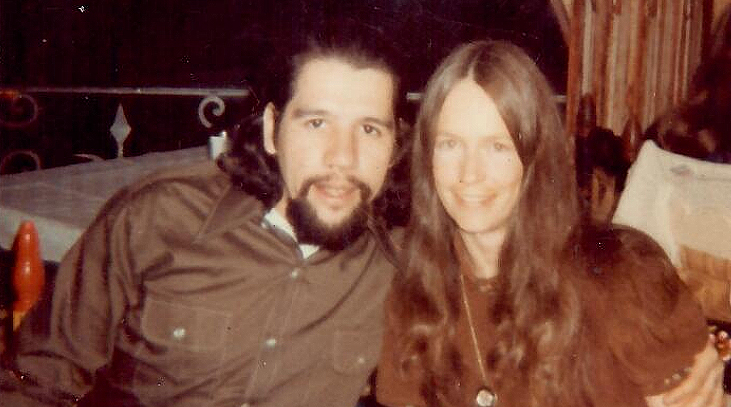
Fifty-seven years later, both have been profoundly changed by the relationship.
Over the decades, they grew from being almost caricatures of their very different types into more whole human beings.
They found ways to allow their differences to become complementary and co-creative—generating not only an electrical current, metaphorically speaking, but a coherent life together.
Not that it was easy.
There were many conflicts, dramas, and obstacles to work through. But clarity, appreciation and direct support for their differences, and an enduring commitment allowed those differences to become part of a transformational journey for both of them.
Neither became the other. But each became far more than either one could have imagined or envisioned in 1970.
And neither could have created that emergence alone.
Their differences did not disappear.
They became part of what the relationship could generate.

What might become possible if we stopped asking difference to disappear—and became curious about what it could generate?
Practice: LISTEN, LISTEN, LISTEN
To the degree that we come to know ourselves and accept our own way of being, we develop the capacity to know others as they are and accept them as different from us, while still authentically themselves.
But first, we have to be willing to listen – and to listen with our authentic self rather than emotions or judgments. Your body tells the truth. Learn more at this link to a brief discussion of Authentic Listening ->
Authentic Listening Practice
Practice: to increase your understanding and knowledge of Authentic Listening, remind yourself to pay attention in some of your one-on-one conversations to what’s happening in your body – sensations and emotions – as you listen.
Think of your entire trunk area as a giant listening ear that can take in ALL the relevant information the speaker is delivering to you, both intellectual and emotional.
When you feel it is appropriate to do so, practice letting the speaker know what your experience has been as you listened.
BE VERY CAREFUL THAT YOU ONLY CONVEY YOUR OWN FEELINGS AS YOU LISTENED – NOT YOUR JUDGMENTS, CONCLUSIONS, OR ADVICE. If you feel compelled to share a similar life experience of your own, make it very brief – just enough detail to let the person know that you’ve been there too.
A Seed of Something More
Difference creates possibility
When two people, perspectives, or ways of being remain distinct, something exists in the space between them that could not exist if they were the same.
Difference may create friction. It may challenge us, unsettle us, or ask us to see beyond what we already know. But when difference can be met with Presence, curiosity, and respect, it can become more than something to overcome.
It can become generative.
Neither side has to disappear. Neither has to become the other. And yet, through relationship, both may be changed—and something genuinely new may become possible.
Perhaps the question is not simply whether we can live with difference.
Perhaps it is:
What might difference make possible that sameness never could?
