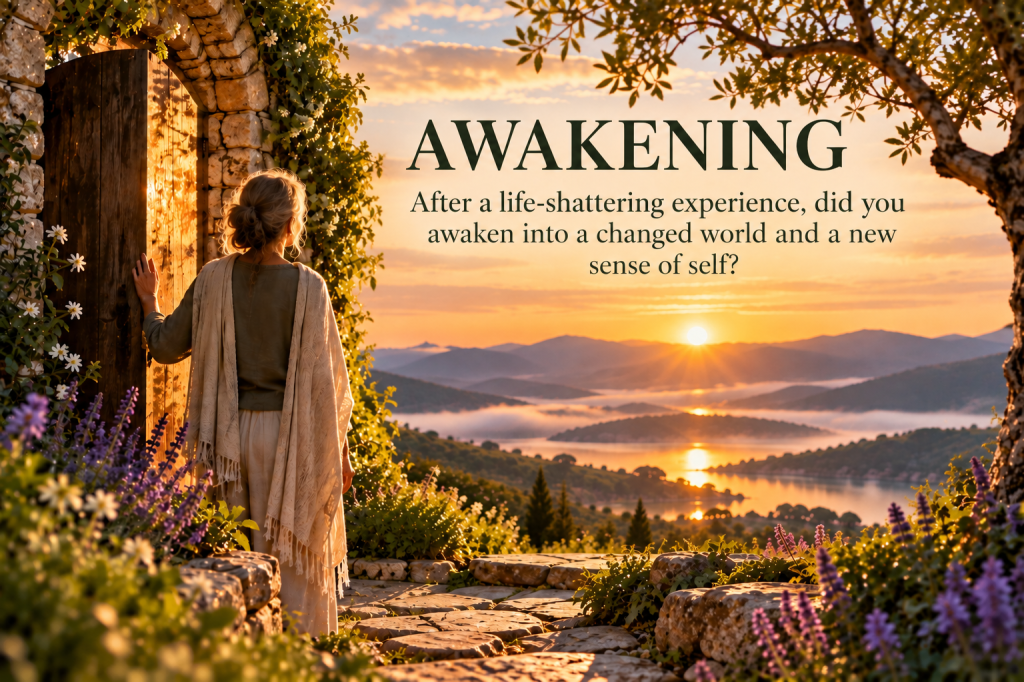
When the Old Normal No Longer Holds
Most of us live within an understanding of how life works.
We know who we are. We have some sense of what is real, what we can count on, and how the pieces of our lives fit together.
And then something happens.
Sometimes it is devastating—a death, an illness, the ending of a relationship, a disaster, or another loss that divides life into before and after.
Sometimes it is something extraordinary—a near-death experience, a mystical or spiritual experience, an unexpected encounter, or a moment of insight that reveals a reality we had never imagined.
The experiences may be very different, but they can have something in common:
The old normal no longer holds.
There is a Buddhist teaching attributed to the Thai teacher Ajahn Chah about a drinking glass. He appreciates the glass, enjoys the way it catches the sunlight, and uses it fully. But he also understands that the glass is already broken. Its existence in its present form was never permanent.
Most of us know that intellectually.
It is quite another thing when our own glass breaks.
Something we thought would continue does not. Something we believed was true can no longer contain what we have experienced. The world may look much as it did before—and yet we are no longer quite the person who inhabited it.
We often call experiences like these life-changing.
But sometimes change is too small a word.
Sometimes an experience disrupts not only the circumstances of our lives, but our understanding of who we are and what is real.
That can be the beginning of awakening.
And awakening is not always comfortable.
We often picture transformation as a caterpillar becoming a butterfly. We admire the wings and celebrate the emergence. But between caterpillar and butterfly is the chrysalis—a period in which the old form is radically reorganized before the new form is ready to emerge.
Human transformation can feel something like that.
I can no longer return to who I was.
But I do not yet know how to live as who I am becoming.
That in-between place can be confusing, lonely, exhilarating, frightening—or all of those at once.
And this is where something important is often overlooked.
The awakening experience and the integration of that experience are not the same thing.
A single moment can change what we believe about life, death, ourselves, or reality.
Learning how to live with what has been revealed may take months or years.
Our relationships may need to change. Our priorities may shift. Old beliefs may fall away before new understanding has found language. Even people who love us may not understand what has happened to us—or why we can no longer simply return to the person we were before.
Perhaps awakening is not only about seeing something we had not seen before.
Perhaps it is also about the long, sometimes difficult work of learning how to inhabit the life that becomes possible afterward.
Sudden Enlightenment: An Awakening of My Own
In 1978, I underwent an extraordinary experience that would change not only my understanding of reality, but nearly every aspect of my life.
It began as an intense, invisible current of what felt like electricity descending through the crown of my head and flowing through my body. Rather than subsiding, the intensity increased each day for approximately ten days.
A very saturated electromagnetic field began to enfold and surround my body. Nothing electrical would operate within at least 10 feet from me. Anyone standing close to me was immediately inducted into my field.
It was something I didn’t understand or know how to handle or ground, and in 1978 there was no internet full of transformational experience advisors.
Along with this came an astonishing change in perception. I seemed to apprehend the meaning of whatever I encountered almost instantly. Connections and understandings that previously required reflection appeared with extraordinary clarity.
Every question I had brought an immediately clear answer. New revelations would arrive unsought. I wrote everything down to help keep track of what was unfolding.
During those ten days, an extraordinarily intense field seemed to surround my body, with effects that were not mine alone to observe. At the hospital where I worked, if I walked into a room filled with electric typewriters, they would stop operating. The elevator would not function with me inside it, and I had to use the stairs. People who came close to me sometimes experienced the intensity themselves, and several were frightened by it.
I understood what was happening as an extraordinarily strong electromagnetic field surrounding my body. Whatever its mechanism, its effects were sufficiently tangible that other people witnessed and responded to them. I didn’t understand what was happening or know how to handle or ground it—and in 1978 there was no internet full of people discussing spiritually transformative experiences, or how to integrate them.
Electrical failures happened around me, sometimes coinciding with particularly intense revelations. Once, while I was in a grocery store waiting to check out, I felt an electrical blue streak descend through me as a new insight registered.
At that moment, the entire shopping center went dark. I experienced these coincidences as connected with what was happening to me, although I had no way to establish their cause.
The experience was exhilarating, overwhelming, and profoundly disruptive. All options were open, from disintegration and collapse to integration and wholeness.
The pivotal factor that would decide the outcome was fear vs. faith: either trust the process or succumb to overwhelming fear. I chose to trust – blind trust – and allowed the transformation to continue.
But the ten days were only the beginning.
For roughly two years afterward, I struggled to integrate what had happened—not merely intellectually, but physically, emotionally, spiritually, and in my relationships with the ordinary world. Every element of my life changed during that time.
My understanding had changed far more rapidly than my capacity to live within it.
I could not simply return to who I had been. Yet becoming able to live as the person I was becoming required a long and sometimes difficult journey.
Awakening had happened. Integration was still unfolding.
Yes, extraordinary experiences can feel intensely physical and can radically disrupt ordinary life. You are not required to deny what you experienced simply because you cannot yet explain it.
Practice: Finding Your Ground
After a life-changing experience, there may be a strong desire to understand what happened.But understanding is only part of integration.
The experience also has to find a place within an ordinary human life—within the body, relationships, work, beliefs, responsibilities, and the small rhythms of everyday living.
You don’t have to understand everything at once.
It may help to begin with a few simple questions:
- What happened to me—as I experienced it?
- What changed in the way I understand myself or my life?
- What no longer fits as comfortably as it once did?
- What seems newly important or meaningful?
- What parts of my experience still have no words?
- Who can listen without needing to explain, dismiss, diagnose, or define the experience for me?
Writing can help. So can talking with someone capable of listening without immediately imposing an interpretation.And sometimes integration means allowing yourself not to know yet.
An extraordinary experience does not have to become a complete philosophy of life overnight.
Meaning may emerge gradually as the experience enters into relationship with the rest of who you are.
The experience happened in its own time. Integration has its own time, too.Explore More Deeply
For people whose lives have been changed by a near-death or other spiritually transformative experience, Integrating the Light explores the journey that begins after the experience itself.It is not about telling you what your experience means. It is about helping you live with what has changed—within yourself, your relationships, and the life you to which you return.
A Seed to Carry With You
Awakening can happen in a moment.
Integration may become the work of a lifetime.
An experience can change what we understand about ourselves or reality before the rest of our lives have had time to change with us. The old way of being may no longer fit, while what comes next has not yet taken form.
Perhaps this in-between place is not simply something to get through.
Perhaps it is part of becoming.
We do not have to discard who we were, nor force ourselves prematurely into who we think we should become. We can allow what has been revealed to enter gradually into relationship with the life we are already living.
Some things may fall away. Some may remain. Others may take on meanings we could not have imagined before.
What if integration is not about returning to normal—but allowing a changed life to find its new form?
