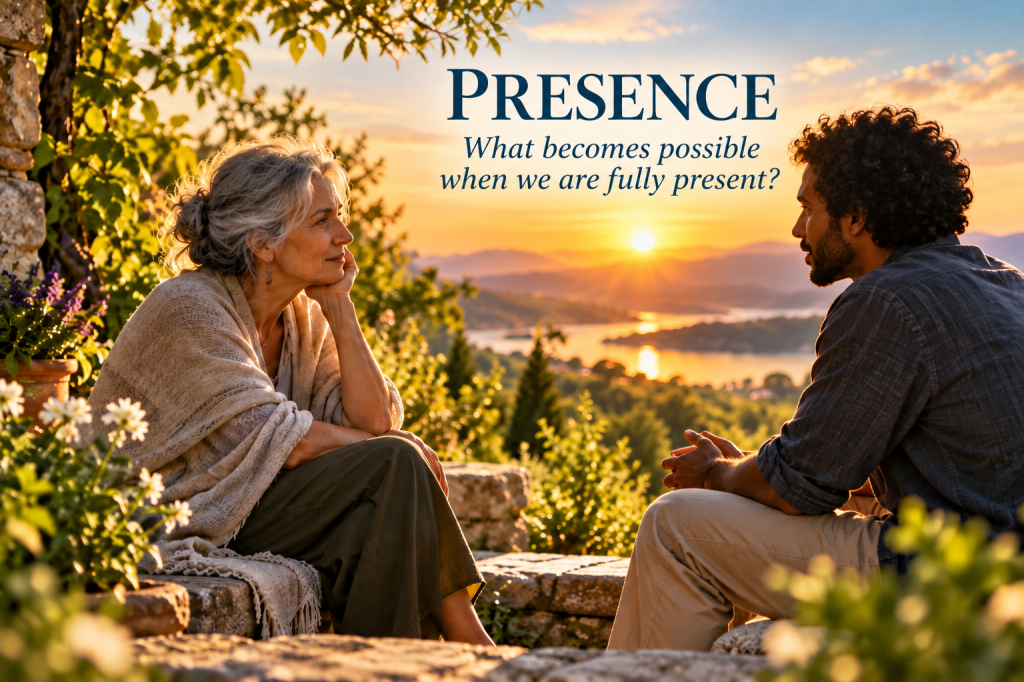
There are moments when another person’s attention changes something in us.
They don’t give advice. They don’t reassure us that everything will be all right. They don’t immediately tell us about something similar that happened to them.
They simply stay.
And somehow, in being fully received by another person, we may begin to hear ourselves differently.
Most of us know the opposite experience as well. We are speaking, but the other person is already preparing an answer. They are solving, evaluating, comparing, defending—or waiting for their turn.
They may hear every word.
And still, we do not feel heard.
What is the difference?
Perhaps listening is not only something we do. Perhaps it is a quality of Presence we bring into relationship.
Presence asks something surprisingly difficult of us: to remain ourselves while making enough room for another person’s experience to reach us.
We don’t have to agree.
We don’t have to approve.
We don’t have to fix anything.
For a little while, we simply allow what is true for another person to exist in our presence without requiring it to become something else.
What becomes possible when someone is received that way?
A Moment of Presence
BE WITH
One afternoon, a young boy from our neighborhood, about age 11 or 12, had a bad accident on his bicycle near our home. When I got to him, he was in a state of both intense pain and panic. He was gasping for breath, eyes wide with fear.
Neighbors were gathering, but he remained alone in the street. I crouched down beside him, took his hand, looked into his eyes, and told him I would be with him no matter what until help arrived.
As he continued to gasp, I asked him to watch me breathe and to match my breath, in and out, with his. Little by little, he began to do so. At first, our shared breaths were brief, but gradually – as I increased the amount air in and then air out, he aligned with that tempo. He calmed, still in pain but no longer overcome with panic.
We stayed in the street, with him prone and me crouched beside him, breathing together until the ambulance arrived. Few words passed between us as we connected with eye contact, hands held together, and rhythmic breath.
When he departed for the hospital in the ambulance, onlookers spoke about how just being with him in those moments with calm, silence, skin to skin warmth, eye contact and shared breath had transformed those moments – not only for him, but for those looking on.
PRACTICE
Can I be with what is happening without immediately trying to make it something else?
- Create intentional moments of presence — Set aside time each day to be fully present with someone, whether a family member, friend, or colleague. Turn off distractions and focus your attention.
- Practice mindful listening — When someone speaks, listen not just to their words but to the emotions behind them. Reflect back what you hear to show understanding.
- Embrace silence — Don’t rush to fill every pause. Sometimes silence speaks louder than words and offers space for reflection and healing.
- Cultivate empathy — Try to see the world through the other person’s eyes. This deepens connection and fosters compassion.
- Be patient with yourself and others — Presence is a skill that grows with practice. Allow yourself grace as you learn to be more fully present.
Explore more deeply
If you would like to explore this way of being more deeply, Embodying Empathy: Being Seen, Heard, Held with Embodied Empathy Transforms Relationships, Deepens Connections, and Builds Trust follows the practice of Presence into a wide range of human relationships and encounters.
It explores what can happen when empathy becomes more than understanding another person—when it becomes something we embody in how we listen, respond, and simply be with one another.
A seed of something more
Presence changes the space between us. What might become possible if we learned how to be more fully here – with ourselves, with one another, and with what is emerging between us?
Presence is one of the conditions through which relationship itself becomes generative, creating new possibilities for both participants.
